2 Days in Athens: The Perfect First-Timer Itinerary
Athens caught us off guard. We arrived expecting a day of ruins before catching a ferry, and ended up wishing we’d given it longer. The city is louder, grittier, and far more alive than its postcard image suggests — a place where a 2,500-year-old temple sits above a neighborhood of rooftop bars, street art, and the best food we ate in all of Greece. Two days isn’t enough to exhaust Athens, but it’s exactly enough to fall for it.
This itinerary is built the way we’d do it again. It’s organized so each day stays in one part of the city: Day 1 is the ancient core — the Acropolis, the Agora, and the old streets of Plaka — and Day 2 is the modern city, its neighborhoods, its markets, and the hilltop views that put the whole place in perspective. The historic center is compact and walkable, so you spend your time seeing Athens rather than crossing it.
Two days is genuinely enough to see the best of Athens before you head to the islands — if you plan it right. Here’s how.
Affiliate disclosure: This post contains affiliate links. If you book or buy something through these links, I may earn a small commission at no extra cost to you. I only recommend things I genuinely use or believe in. Learn more.
Quick Summary
| Best time to visit | April–May or September–October; early June can work but feels hotter |
| How many days | 2 days ideal for the city, 3 if adding a day trip |
| Best area to stay | Plaka, Koukaki, or Monastiraki |
| Getting around | Walking + the metro (clean and cheap) |
| Don’t miss | Acropolis at opening + sunset from Filopappou Hill |
| Book in advance | Acropolis ticket, summer ferries, and any Cape Sounion or Delphi day trip |
| Best for | First-timers, couples, history and food lovers |
Table of Contents
The map below groups both days by area — the ancient core around the Acropolis on Day 1, and the modern neighborhoods and viewpoints on Day 2 — so you can see how each day stays walkable before you plan transport and where to stay.
Before You Book Athens
Athens rewards a little planning and punishes none of it. Book the few things that genuinely sell out, choose a central base, and the rest of the city opens up on foot. Use this as the decision filter before you spend money.
| Book first | The Acropolis is the one ticket worth securing ahead — timed entry matters, and the morning slots and guided tours go fast in summer. Start with Acropolis tickets and guided tours on Viator, then pick the earliest realistic slot. |
| Best base | For two days, stay in Plaka for charm and walkability, Koukaki for a local feel beside the Acropolis Museum, or Monastiraki for nightlife and transport. Book a refundable hotel and recheck the price before the free-cancellation deadline. |
| Best splurge | Spend on one thing that changes the trip: a guided Acropolis tour that brings the ruins to life, or a sunset day trip to the Temple of Poseidon at Cape Sounion. Choose one, not five. |
| Transport choice | Do not rent a car for Athens — you won’t need it and the traffic and parking are miserable. The metro from the airport is fast and cheap, and the historic center is walkable. If you continue to the islands, compare ferry times before you lock the next hotel, and book ahead in summer. |
| Money move | Use the travel money card guide before relying on airport exchange desks, and the eSIM guide covers getting data the moment you land for maps and ferry apps. |
| Planning order | Book flights and refundable accommodation first, then your Acropolis slot, then any day trip or ferry. The full trip planning guide walks through the order so you don’t build an impossible itinerary. |
The 2-Day Athens Itinerary at a Glance
Here’s the logic behind the two days — each one stays in a single part of the city so you walk it rather than commute across it:
- Day 1: Ancient Athens — the Acropolis at opening, the Acropolis Museum, the Ancient Agora, the old streets of Plaka and Anafiotika, and sunset from Filopappou Hill
- Day 2: Modern Athens — the Temple of Olympian Zeus, the Panathenaic Stadium, the Changing of the Guard at Syntagma, Lycabettus Hill, the Central Market, and dinner in Psyrri or Koukaki
Book one thing before you leave home: the Acropolis. Everything else on this itinerary can be handled on the day or skipped without breaking the plan.
Day 1: Ancient Athens — the Acropolis, Agora, and Plaka
Day 1 is the Athens you came for: the Acropolis crowning the city, the Agora where democracy was argued into existence, and the tangle of old streets below. It’s also the day that rewards an early start more than any other — the Acropolis bakes by midday in summer, with almost no shade and a crowd that thickens by the hour. The difference between an 8am and an 11am arrival is the difference between a memory and an ordeal.
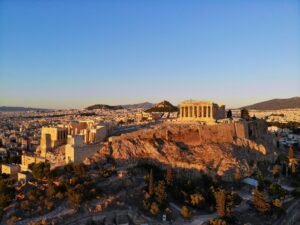
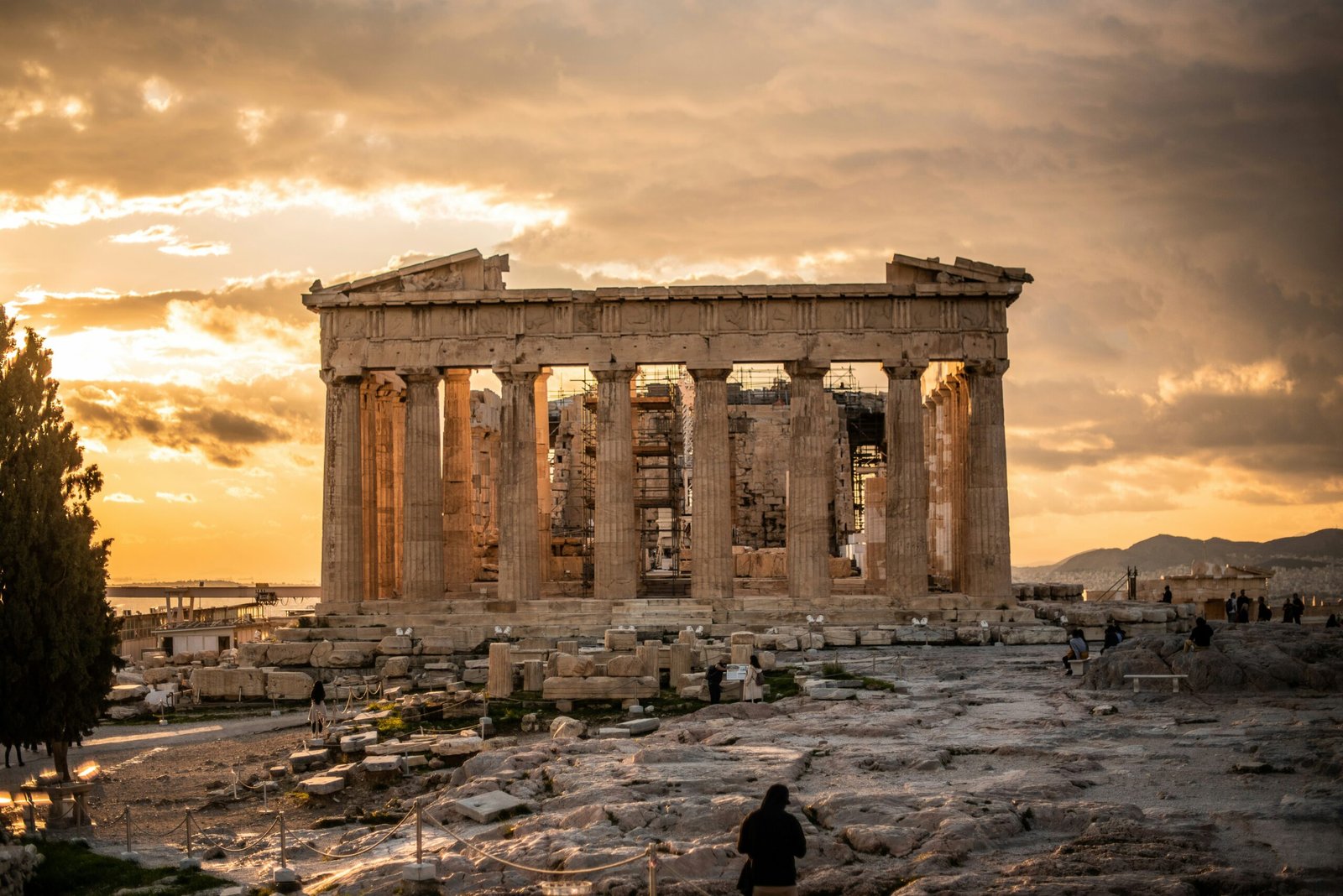
Morning: the Acropolis. Start here, and start at opening. The Acropolis opens at 8am, and the first hour is the one to book — cooler air, softer light, and space to actually take it in before the tour groups arrive. The Parthenon is the headline, but the whole plateau rewards a slow walk: the Erechtheion with its porch of caryatids, the tiny Temple of Athena Nike on the bastion, the Propylaea gateway, and the views over the entire city from the edge. Give it 1.5 to 2 hours. A guided tour adds the context that turns scattered marble into a story you’ll remember.
Tickets are timed and sell out in peak season, and the standard Acropolis ticket also covers the slopes (the Theatre of Dionysus on the way up). Book before you arrive — a timed entry, or a guided tour if you want the history explained properly. You can compare Acropolis tickets and guided tours on Viator. If you plan to visit several ancient sites, check the current official ticket options before assuming an old-style combined pass still applies. The Acropolis, the museum, and the smaller archaeological sites are not always bundled the way older guides describe, so price the ruins you actually want instead of buying a broad pass by habit. Family note: the marble is slippery and the slopes are uneven — proper shoes matter, and a carrier works better than a stroller up top.
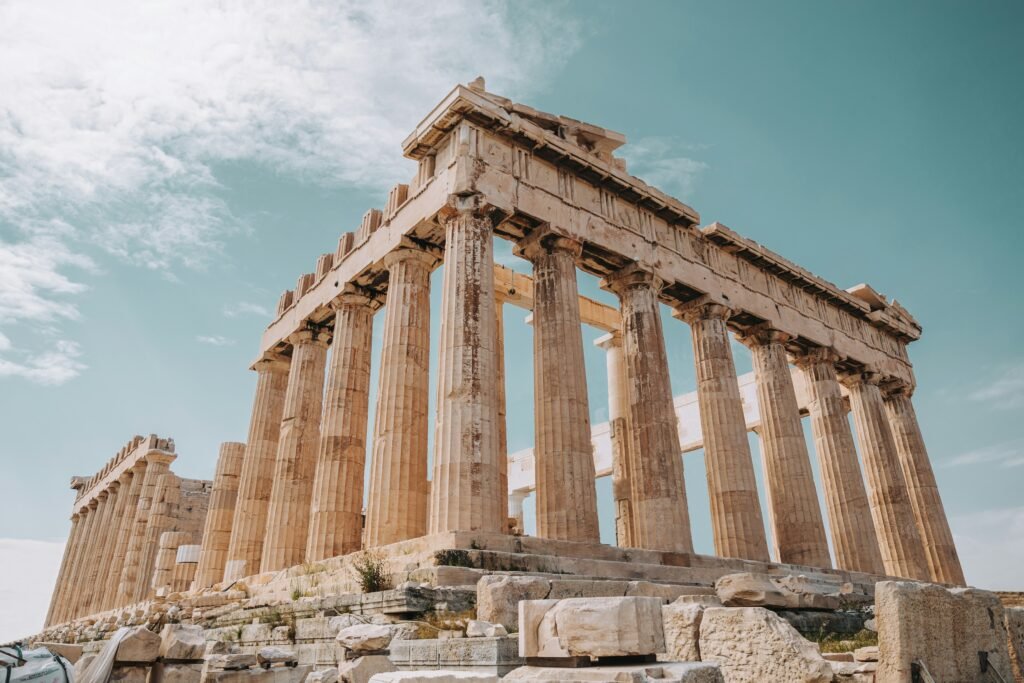
Late morning: the Acropolis Museum. A short walk downhill, the Acropolis Museum is one of the best modern museums in Europe and the perfect companion to the hill you just climbed. The glass-floored galleries display the original sculptures and friezes (the ones on the monuments themselves are copies), and the top floor — aligned exactly with the Parthenon, visible through floor-to-ceiling glass — lays out the marble frieze the way it once wrapped the temple. Budget 1 to 1.5 hours. The café terrace has a genuinely good Acropolis view if you need a coffee.
Lunch: Koukaki or Plaka. Walk into Koukaki, the neighborhood just south of the museum — calmer than the tourist core, full of tavernas and cafés where Athenians actually eat. It’s a far better lunch than the menu-in-six-languages spots right by the sites. For something more atmospheric, the edges of Plaka (away from the busiest souvenir streets) do classic Greek food in pretty surroundings.
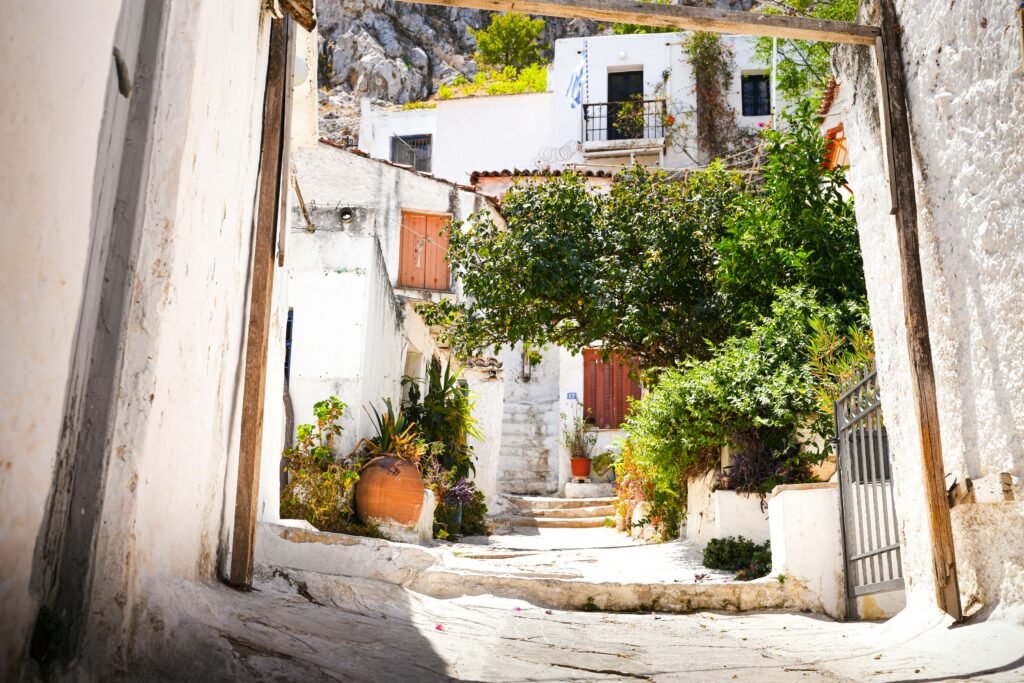
Afternoon: the Ancient Agora and Plaka. The Ancient Agora was the heart of public life in classical Athens — marketplace, courthouse, and the open ground where Socrates argued with anyone who’d listen. The remarkably intact Temple of Hephaestus stands at the top, one of the best-preserved Greek temples anywhere, and the reconstructed Stoa of Attalos houses a small museum. From there, wander up into Plaka — the oldest neighborhood in the city, a maze of neoclassical houses, bougainvillea, and stepped lanes — and into Anafiotika, a tiny pocket of whitewashed, Cycladic-style houses built into the slope below the Acropolis by island craftsmen. It feels like a village glued to the side of the city. Family note: Plaka and Anafiotika are flat-to-gently-stepped and made for slow wandering — a relief after the Agora’s rough ground.
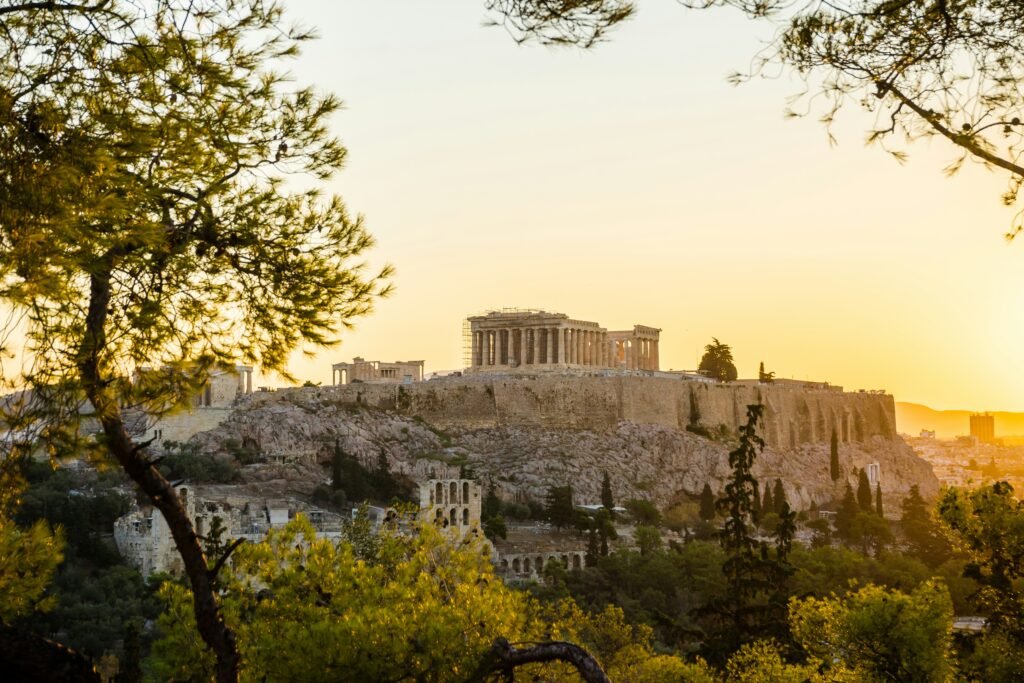
Sunset: Filopappou Hill. End the day on Filopappou Hill (the Hill of the Muses), a short, easy climb through pine woods to one of the best free views in Athens — the Acropolis at eye level, glowing gold as the sun drops, with the city and the sea beyond. It’s calmer and greener than the more famous Areopagus Rock next to the Acropolis (which is also free, but slippery and packed at sunset). Bring water and take your time.
Dinner: Psyrri or Plaka. Psyrri, just north of Monastiraki, is the city’s most fun dinner neighborhood — meze tavernas, tiny live-music spots, and streets that fill up late the way they do all over Greece. Order a spread of small plates and don’t rush it. If you’d rather stay close, the quieter corners of Plaka do a lovely, lantern-lit version of the same.
Day 2: Modern Athens — Stadium, Syntagma, and the Neighborhoods
Day 2 is the city the guidebooks under-sell — the grand 19th-century boulevards, the neighborhoods where Athens actually lives, the markets, and the hilltop that gives you the whole place at a glance. There’s no single ticket to stress about and no rigid schedule; this is a day for walking, eating, and looking out over the city.
Morning: Temple of Olympian Zeus and the Panathenaic Stadium. Start at the Temple of Olympian Zeus, once the largest temple in Greece — a handful of colossal columns still standing, with Hadrian’s Arch right beside it. A few minutes’ walk away is the Panathenaic Stadium (Kallimarmaro), the gleaming white marble stadium that hosted the first modern Olympics in 1896 and is the only stadium in the world built entirely of marble. You can go in and run the track, or just admire it from the gate. Both sit on the edge of the National Garden, a shady, free park that’s a welcome break from the heat.
Late morning: Syntagma Square and the Changing of the Guard. Walk up through the National Garden to Syntagma Square and the Greek Parliament, where the Evzones — the guards in traditional uniform, complete with pom-pommed shoes — perform the Changing of the Guard at the Tomb of the Unknown Soldier. It happens every hour on the hour; the full ceremony, with the marching band, is on Sundays at 11am. It’s brief, formal, and genuinely worth timing your morning around.

Lunch: the Central Market and Monastiraki. Head toward the Varvakios Agora, the boisterous central market — the meat and fish halls are not for the faint-hearted, but the surrounding streets are full of spice shops, delis, and old-school tavernas that have fed market workers for a century. From there it’s a short walk to Monastiraki, with its flea market, the Roman Agora and the Tower of the Winds, and rooftop cafés looking straight up at the Acropolis. It’s touristy but genuinely fun, and the people-watching is excellent.
Afternoon: Lycabettus Hill. For the highest view in Athens, ride the funicular (or walk, if it’s not too hot) up Lycabettus Hill — at 908 feet (277 m), it’s the tallest point in the city, with a little chapel at the top and a 360-degree panorama that takes in the Acropolis, the sprawl of the city, and the sea glinting at Piraeus. Late afternoon is best, when the light goes warm and the heat eases. It’s the moment Athens finally makes sense as a whole.
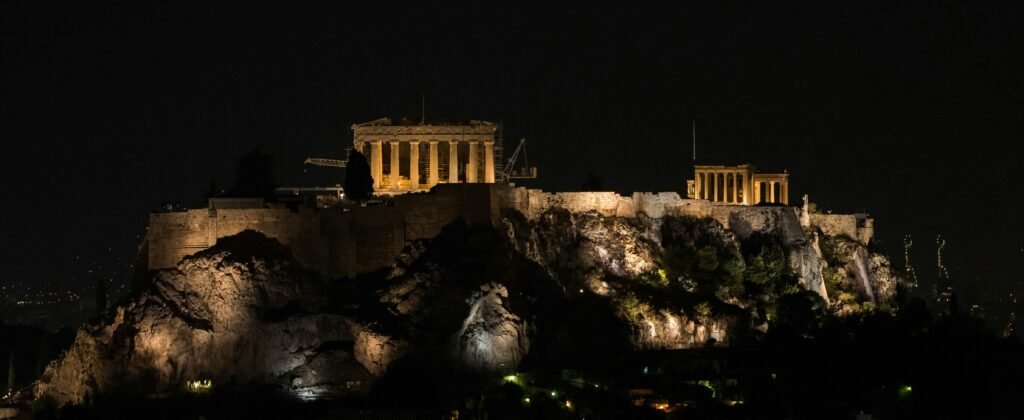
Evening: Koukaki or a rooftop with a view. For the last night, Koukaki and Pangrati are the neighborhoods Athenians point you to — relaxed, full of good modern tavernas and wine bars, and far from the tourist markup. Or book a rooftop bar with an Acropolis view and watch it light up after dark — touristy, yes, but the Parthenon glowing above the city with a glass of something cold in your hand is exactly the right way to end two days in Athens.
If You Have More Time (or Less)
Only 1 day? Keep Day 1 almost intact — the Acropolis at opening, the Acropolis Museum, and a walk through the Agora and Plaka — then add the Changing of the Guard at Syntagma in the late afternoon and a sunset on Filopappou Hill. You’ll skip the modern-city wandering and the markets, but you’ll see the essentials.
Have a 3rd day? Add a day trip. The sunset at the Temple of Poseidon at Cape Sounion — about 43 miles (70 km) down the coast, roughly 1.5 hours each way — is the classic and genuinely magical; you can compare Cape Sounion sunset tours on Viator. Delphi, about 112 miles (180 km) northwest, is the other great option — the ancient oracle on the slopes of Mount Parnassus, a full day but unforgettable. For something gentler, a Saronic island like Hydra or Aegina is an easy ferry away.
Heading to the islands? Athens is the gateway. Our 12-day Greece itinerary picks up where this leaves off, pairing Athens with the Cyclades, and if Zakynthos is on your list, our how to get from Athens to Zakynthos guide covers the ferry and flight options.
Where to Stay in Athens for 2 Days
For a two-day trip, stay central and walkable — you want to step out of your hotel into the city, not commute into it. Three neighborhoods get it right, each with a different character:
- Plaka: The most charming base — neoclassical streets, walking distance to the Acropolis and the Agora, and pretty at every turn. Touristy and not the cheapest, but for two days the location is worth it. Compare options on Expedia or Booking.com.
- Koukaki: Our pick for most first-timers — a real Athens neighborhood right beside the Acropolis Museum, full of cafés and tavernas, walkable to everything, and better value than Plaka. Compare on Expedia or Booking.com.
- Monastiraki: The most lively base — central, on the metro, surrounded by nightlife and rooftop bars, and a short walk from the sites. Best if you want to be in the middle of the action and don’t mind the noise. Compare on Expedia or Booking.com.
Where to avoid: the area around Omonia Square and parts of Exarcheia can feel gritty and uncomfortable after dark, and they’re a long walk from the sights. For two days, the extra cost of a central neighborhood pays for itself in time, walking, and peace of mind.
What 2 Days in Athens Actually Costs
Athens is one of the better-value capitals in Europe — the food is excellent at every price level, many of the best experiences (the hilltop sunsets, Plaka, the markets, the Changing of the Guard) are free, and the main costs are accommodation and a couple of tickets. Here’s a realistic per-person breakdown for two people sharing a room:
| Expense | Budget-conscious | Comfortable | Splurge |
|---|---|---|---|
| Accommodation (per night) | €60–90 | €100–170 | €220+ |
| Food (per day) | €25–35 | €45–70 | €100+ |
| Attractions (per day) | €15–30 | €35–60 | €90+ |
| Transport (per day) | €3–6 | €8–15 | €30+ (taxis) |
Where the money goes: the Acropolis ticket (the official 2026 listing shows €30), the Acropolis Museum (general admission is €20), any smaller archaeological sites you add, and any guided tour or day trip. Almost everything else — the views, the neighborhoods, the markets — is free. Food is where Athens rewards you: a spread of mezedes at a neighborhood taverna costs a fraction of a tourist-strip meal and tastes far better. The single best money-saving move is the same as in Rome — walk two or three streets away from any major sight before you eat or drink.
Shoulder season tip: visiting in spring or fall instead of peak summer noticeably lowers accommodation prices for the same hotels — and the weather is far better for walking, which is what you’ll be doing all day.
Getting Around Athens
Walk. The historic center — Acropolis, Plaka, Monastiraki, Syntagma — is compact and genuinely best on foot, much of it along a pedestrianized archaeological promenade. Wear proper shoes; the marble and old stone are slippery and uneven.
Metro: Clean, cheap, and easy. Three lines cover everything you’ll need, with Monastiraki and Syntagma as the central hubs. A single ticket is €1.20 and covers 90 minutes including transfers; a 24-hour ticket is good value if you’ll ride several times a day. Watch your bag on the busiest lines.
From the airport: Metro Line 3 (Blue) runs straight from Athens International Airport to Syntagma and Monastiraki in about 40 minutes for €9 one-way — the simplest option. The X95 express bus to Syntagma is cheaper at around €5.50 but slower in traffic. Official taxis use a fixed fare to the center (about €40 by day, €55 at night). If you’re continuing to the islands or another city, you can compare ferries, buses and trains on Omio and book ahead — summer ferries to the popular islands fill up. For maps, ferry apps, and tickets on the go, the eSIM guide covers setting up a Greek data plan before you land.
Is Athens Worth It?
Yes — and it’s better than its reputation. Athens is often treated as a one-day stopover on the way to the islands, and that does it a real disservice. This is a city where you stand inside 2,500 years of history in the morning and eat some of the best food in the Mediterranean at night, where the views are free and the energy is real. Two days is enough to see why it’s worth more than the stopover most people give it.
Worth it if: you have any interest in history, food, or cities with genuine character, you’re willing to book the Acropolis ahead, and you start your mornings early to beat the heat and crowds.
Less ideal if: you’re visiting in the peak of July or August expecting a relaxed city break — the heat is punishing and the Acropolis is at its most crowded. If summer is your only option, do everything outdoors early and save the museum and a long lunch for the afternoon.
What Most Visitors Get Wrong
- Treating Athens as a single stopover day. The city deserves two — one for the ancient core, one for the neighborhoods and views. Rushing it is the most common regret.
- Climbing the Acropolis at midday. In summer it’s hot, shadeless, and packed by late morning. Go at opening or skip to late afternoon — never the middle of the day.
- Eating right next to the sights. The tavernas with photo menus and a view of the Acropolis have the worst food and the highest prices. Walk a few streets into Koukaki, Psyrri, or Pangrati and both improve dramatically.
- Skipping the Acropolis Museum. People do the hill and move on — but the museum is where the sculptures make sense, and it’s one of the best in Europe. Don’t miss it.
- Not booking the Acropolis ticket ahead. Walk-up timed slots sell out in summer, and the queue in the heat is brutal. Book before you fly.
Best Time to Visit Athens
April–May is the best spring window — warm but comfortable (typically 65–80°F / 18–27°C), long days, and manageable crowds before the summer peak. Early June can still work, but it already feels more like summer.
September–October is the other excellent window — the worst of the heat has broken, the light is beautiful, and prices ease after August. October is one of the best months for walking the city.
July–August is hot and crowded — daytime temperatures regularly top 90°F (32°C) with little shade at the ancient sites. If summer is your only option, start every day at opening and retreat indoors or to a long lunch in the afternoon heat.
November–March is the quiet season — mild (around 50–60°F / 10–16°C), occasional rain, but far fewer crowds and the lowest prices of the year. The sites are calm and the city feels local. A good choice if you don’t mind cooler days and the odd shower.
Frequently Asked Questions
Is 2 days enough for Athens?
Yes — two days is enough to see the essentials of Athens without rushing: the ancient core (the Acropolis, the Acropolis Museum, the Agora, and Plaka) on Day 1, and the modern city, markets, and hilltop views on Day 2. You won’t see everything, but you’ll cover what defines the city and still have time for long lunches and a sunset. A third day lets you add a trip to Cape Sounion or Delphi.
What should you book in advance for Athens?
Mainly the Acropolis — timed-entry tickets sell out in peak season and the walk-up queue is long and shadeless. Book a timed entry or a guided tour before you arrive. If you’re adding a day trip to Cape Sounion or Delphi, book that ahead too, and reserve summer island ferries early. The Acropolis Museum and the smaller ancient sites can usually be handled separately, but always check current ticket rules before assuming a multi-site pass still exists.
Where should you stay in Athens for a first visit?
Koukaki is the best all-round choice for a first visit — a real neighborhood beside the Acropolis Museum, walkable to everything, and better value than the tourist core. Plaka is the most charming if you want to be in the middle of the old streets, and Monastiraki is the most lively, with nightlife and easy metro access. Avoid the area around Omonia Square, which is cheaper but can feel uncomfortable after dark.
Do you need a car in Athens?
No — and you actively don’t want one. The historic center is compact and best on foot, the metro is clean and cheap and runs to the airport, and Athens traffic and parking are genuinely stressful. Save a rental car for exploring the mainland or skip it entirely and take a guided day trip to places like Cape Sounion or Delphi.
What is the best time to visit Athens?
April–May and September–October are the best windows — warm but not punishing, with manageable crowds and better prices than the summer peak. Avoid July–August if you can: daytime temperatures regularly top 90°F (32°C) with little shade at the ancient sites. November–March is the quiet, cheaper season for travelers who don’t mind cooler weather and the occasional rainy day.
More Greece Travel Guides
- Planning the whole country? Our 12-day Greece itinerary pairs Athens with the islands, with the full route and ferry timing.
- Island-bound? Our best beaches in Zakynthos guide and how to get from Athens to Zakynthos cover one of the most beautiful islands in Greece.
- Still booking? Our cheap flights guide and trip planning guide cover getting to Greece and putting the whole trip together.