eSIM for Travel: Is It Worth It? (Honest Guide for 2026)
Affiliate disclosure: This post contains affiliate links. If you book or buy something through these links, I may earn a small commission at no extra cost to you. I only recommend things I genuinely use or believe in. Learn more.
I used to land at a foreign airport, turn airplane mode off, watch my phone connect to some random local network, and then spend the next 20 minutes either finding free wifi or accepting that I was going to pay my home carrier’s roaming rates. Then I switched to eSIM. I have not thought about mobile connectivity abroad since. Here is exactly how it works, whether it is worth the cost, and which providers I actually recommend.
Connectivity is one of those travel logistics that sounds minor until it goes wrong — especially when you have a toddler in tow, need Google Maps in real time, or are trying to find a restaurant at 9pm in a city you do not know. If you are still sorting the rest of your trip logistics, our complete trip planning guide covers everything from flights to accommodation. And once you are sorted on connectivity, make sure your travel money card setup is ready too — the two together mean you land prepared for everything.
| eSIM for Travel: Quick Summary | |
|---|---|
| Best overall eSIM provider | Airalo — largest coverage, competitive prices, easy app |
| Best for Europe | Airalo or Holafly — both excellent, price-check before each trip |
| Best for Japan | Airalo Japan eSIM — reliable coverage, good data speeds |
| Best for USA travel | Airalo USA eSIM — T-Mobile network, strong coverage |
| When to activate | Before you board — never at the airport scrambling |
| Is it worth it? | Yes — almost always cheaper than roaming, always more convenient |
What Is an eSIM and How Does It Work?
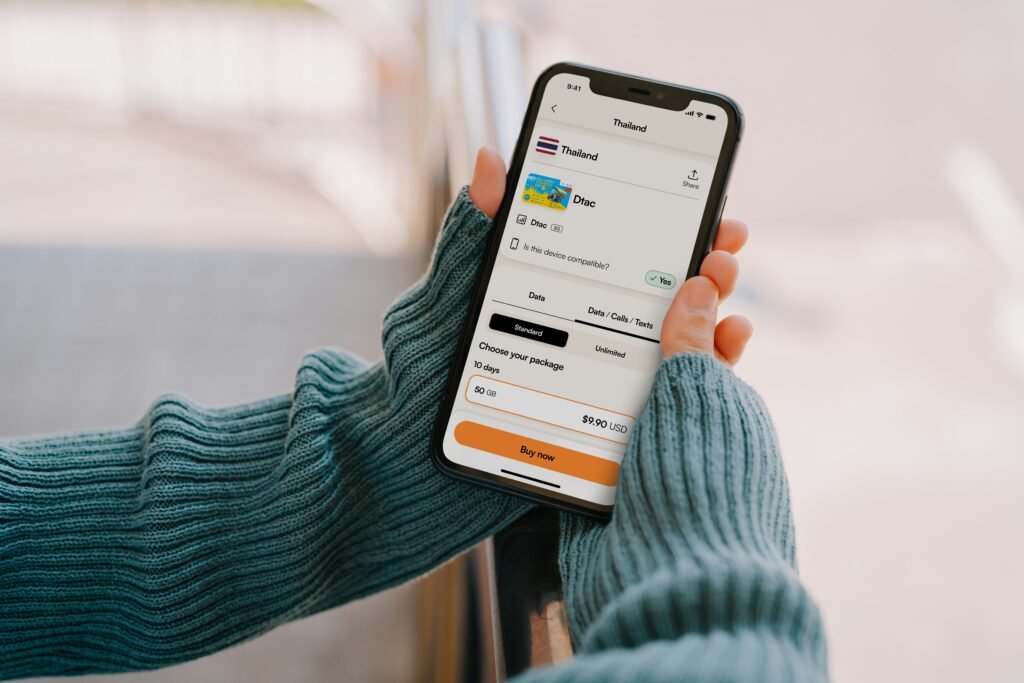
A traditional SIM card is a physical chip you insert into your phone. An eSIM (embedded SIM) is a digital version built into the phone itself — you activate it by scanning a QR code or downloading a profile through an app, with no physical card required.
In practice, this means you can buy a local data plan for your destination before you leave home, activate it on the plane, and land with a working data connection already running on your phone. Your home number stays active on your primary SIM — you can still receive calls and texts — while the eSIM handles your data at local rates.
Most smartphones made since 2018 support eSIM. iPhone XS and later, Samsung Galaxy S20 and later, Google Pixel 3 and later. Check your phone settings under “Mobile Data” or “SIM & Network” — if you see an “Add eSIM” or “Add Data Plan” option, your phone is compatible.
eSIM vs Roaming vs Local SIM: The Real Cost Comparison
The numbers vary by destination and carrier, but here is a representative comparison for a one-week trip to Europe:
| Option | Cost (1 week, Europe) | Setup | Speed |
|---|---|---|---|
| Home carrier roaming | $50–120+ (or daily rates $10–15/day) | None needed | Good but throttled on some plans |
| Local SIM at destination | $10–25 | Find a shop, queue, paperwork | Excellent — full local speeds |
| eSIM (Airalo / Holafly) | $8–20 | Buy online, activate via QR | Excellent |
For most trips, an eSIM is cheaper than roaming and easier than buying a local SIM. The only scenario where a local SIM wins on price is a very long trip (3+ weeks) in a single country where local operators offer monthly plans. For anything shorter, eSIM is the better call.
Airalo vs Holafly: Which eSIM Provider Is Better?
These are the two providers I have used across multiple trips. Both are reliable — the differences are in pricing model and coverage.
| Airalo | Holafly | |
|---|---|---|
| Pricing model | Pay per GB (e.g., 1GB, 3GB, 5GB) | Unlimited data plans |
| Price range (Europe, 7 days) | $8–16 depending on data amount | $19–27 for unlimited |
| Coverage | 200+ countries and regions | 150+ countries |
| App quality | Excellent — clean and easy | Good |
| Best for | Light to moderate data users | Heavy data users, video calls |
| Calls included | Data only (no calls) | Data only (no calls) |
Airalo: Best eSIM for Most Travelers
Airalo is my default choice for most trips. The coverage is the widest of any eSIM provider — over 200 countries — which matters when you are combining multiple destinations in one trip or going somewhere less common. The app is genuinely good: clear pricing, easy QR activation, and you can manage multiple eSIMs for different countries from one place.
The data-based pricing works well for most travelers. On a typical week in Europe I use 2–4GB — maps, browsing, messaging, the occasional photo upload. A 3GB Airalo Europe plan costs around $12. That is considerably less than my home carrier’s roaming rate and requires zero effort at the destination.
Get your Airalo eSIM here: airalo.com — buy before you travel, activate on the plane.
Holafly: Best for Heavy Data Users
Holafly’s unlimited data model makes sense if you are making video calls, streaming, or using a lot of data daily. The price is higher than Airalo for light users but predictable — you are not watching a data counter throughout the trip. For a family trip where multiple devices might be using hotspot, or for a work trip with a lot of video meetings, Holafly’s unlimited plan can be worth the premium.
Get your Holafly eSIM here: holafly.com — use code for a discount on first purchase.
Best eSIM for Japan Travel
Japan deserves a specific mention because it is one of the most searched destinations for travel eSIMs — and for good reason. Japan’s mobile infrastructure is excellent and local SIMs at the airport are expensive and involve paperwork. An Airalo Japan eSIM (typically $10–18 for 7 days, 3–5GB) activates before you land and works reliably on Softbank or Docomo networks throughout the country, including rural areas and train routes.
One Japan-specific note: some older train station ticket machines and convenience store terminals do not accept foreign payment cards, so having data connectivity to find an alternative or navigate is more important in Japan than almost anywhere else. An eSIM is essentially required on a Japan trip. Browse Japan eSIM options on Airalo here.
Best eSIM for USA Travel
For international visitors to the USA, an eSIM is the cleanest solution — US local SIMs require ID and in-person purchase, which is cumbersome. The Airalo USA eSIM runs on T-Mobile’s network, which has strong coverage across major cities and reasonable rural coverage. A 7-day 3GB plan typically costs around $13. For a trip to cities like New York, Chicago, or Washington DC, this is more than enough data. Browse USA eSIM options on Airalo here.
How to Set Up an eSIM Before You Travel
The setup takes about five minutes and should be done at home, not at the airport:
- Step 1: Check your phone is eSIM compatible (Settings > Mobile Data or SIM > “Add eSIM” option)
- Step 2: Buy your eSIM on Airalo or Holafly — choose your destination and data amount
- Step 3: You receive a QR code by email — scan it in Settings > Mobile Data > Add eSIM
- Step 4: The eSIM installs on your phone but stays inactive until you enable it
- Step 5: On the plane (or just before landing), enable the eSIM in settings — you land connected
Important: Most eSIMs start counting your data allowance from the moment you activate them, not from when you first use data. Activate on the plane, not at home two days before departure.
| Before Your Trip: eSIM Checklist | |
|---|---|
| Check phone eSIM compatibility | Settings > Mobile Data > Add eSIM |
| Buy eSIM for your destination | Airalo or Holafly |
| Save QR code to photos (backup) | In case email is inaccessible offline |
| Activate on the plane | Enable in Settings when descending |
| Turn off home carrier data roaming | Avoids accidental roaming charges |
Why eSIM Matters Even More When Traveling with a Toddler
Traveling with a young child changes your relationship with connectivity. You need Google Maps working constantly — not “mostly working when wifi is available.” You need to be able to contact your accommodation immediately if something runs late or changes. You need to look up a pharmacy, find a family-friendly restaurant, check which metro line goes where. All of this requires reliable data, not wifi hunting.
The specific scenarios where an eSIM has saved us time and stress traveling with our son:
- Real-time navigation in cities we did not know, with a tired toddler who needed to reach the hotel quickly
- Looking up the nearest pediatric pharmacy when we needed it unexpectedly
- Downloading offline content on the plane when the in-flight entertainment was not toddler-appropriate
- Messaging the hotel about an early check-in while still at the airport
Revolut’s virtual card also pairs well here — if you need to buy something quickly while managing a child, having your travel money card ready on your phone means one less thing to fumble with.
Common eSIM Questions Answered
Can I still receive calls and texts with an eSIM?
Yes. Travel eSIMs are data-only — they do not replace your home number. Your primary SIM stays active for calls and texts. The eSIM just handles your data connection at local rates. WhatsApp, FaceTime, and other data-based calls all work over the eSIM data connection.
Can I use an eSIM as a hotspot?
Most Airalo and Holafly plans allow hotspot use, but check the specific plan before buying — some regional plans restrict tethering. If you need a hotspot for a tablet or laptop, choose a plan that explicitly allows it and consider getting a larger data allowance.
What if my phone does not support eSIM?
Older phones (pre-2018 generally) and some budget Android devices do not support eSIM. In that case, a local SIM at your destination is still the best alternative to roaming. Many airports and city center phone shops sell tourist SIM cards with reasonable data allowances. Just factor in the time and effort of buying one on arrival.
How do I know how much data I need?
For a typical week of travel — maps, messaging, browsing, social media — 3GB is usually sufficient. If you plan to stream video, make video calls, or upload a lot of photos, go for 5GB or more. Holafly’s unlimited plan removes the guesswork if you are unsure or tend to use a lot of data.
Is an eSIM Worth It?
Yes — almost always. For the cost of two coffees, you get a week of reliable local data that costs a fraction of roaming rates and requires zero effort at the destination. The setup takes five minutes at home. The alternative — scrambling for wifi, paying roaming rates, or queuing at an airport SIM shop — costs more in money or time or both.
The only exception: if your home carrier already includes free or cheap international data (some plans do), check whether an eSIM actually saves you money before buying one. Run the numbers. But for most travelers on standard carrier plans, an eSIM for every international trip is a straightforward yes.
| Get Your Travel eSIM | |
|---|---|
| Airalo — best overall, 200+ countries, data-based pricing | Buy on Airalo |
| Holafly — unlimited data plans, great for heavy users | Buy on Holafly |
Final Thoughts: eSIM for Travel in 2026
An eSIM is now a standard part of how I prepare for any international trip — alongside booking with free cancellation, setting up Wise and Revolut, and making sure the itinerary is properly planned. It takes five minutes to set up and removes an entire category of travel stress. That is a good deal.
For everything else that goes into preparing a trip well, our complete trip planning guide covers the full process. For the money side — paying abroad without fees, earning points on travel spending — our travel money card guide has the full setup. And if you are trying to save on the flight itself, our cheap flights guide covers the system that actually works.