Fall in New York City: What to Do, See & Expect
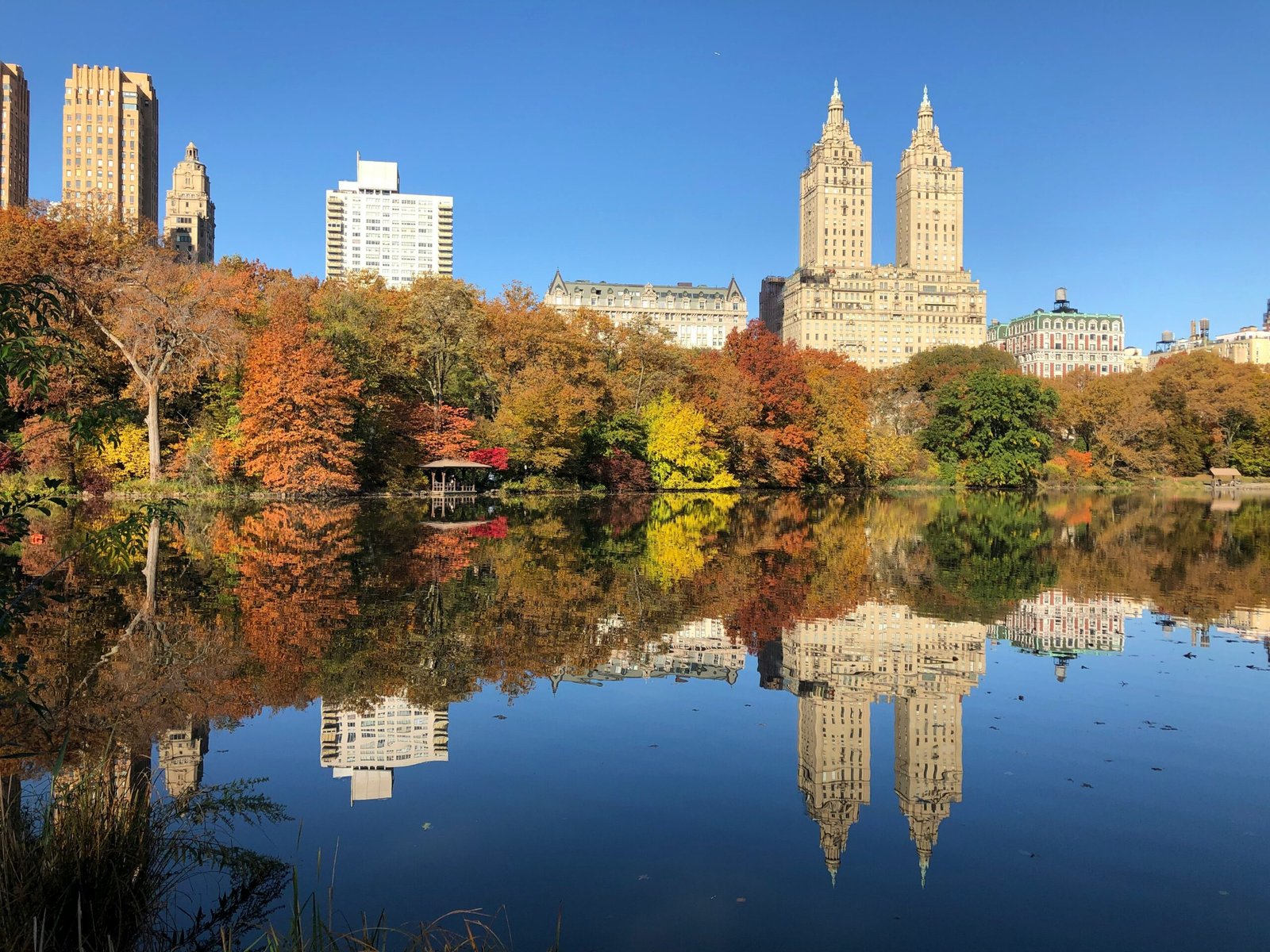
New York in fall doesn’t announce itself quietly. The maples in Central Park turn amber by mid-October, the air drops to that exact temperature where a leather jacket feels like a good idea, and the city — which never really slows down — shifts into something that feels almost like a different gear. The insufferable August heat is gone. The holiday crowds haven’t arrived yet. What’s left is New York at the height of its powers: all the energy, all the food, all the culture, with none of the sweaty subway misery.
If you’ve been waiting for the right time to visit, this is it.
Quick answer: Fall in New York City runs from late September through late November. Peak foliage hits Central Park and Prospect Park around mid to late October. September is warm and lively; October is the sweet spot for weather and color; November is quieter and cooler but still excellent for culture and events. Book accommodation early — October especially fills fast.
Contents
- Why Fall Is New York’s Best Season
- Best Things to Do in NYC in Fall
- Best Fall Events in NYC (September–November)
- Where to See Fall Foliage in NYC
- What to Wear & Pack
- FAQ
This post contains affiliate links. If you book or buy something through them, I may earn a small commission — at no extra cost to you. I only recommend things I would genuinely consider useful for planning this trip.
Before you go — quick links
- Central Park fall walking tour — a guided 2-hour walk through the park’s best fall foliage spots, with expert commentary on the history and landscape. compare Central Park fall walking tours on Viator.
- Fall foliage Hudson River cruise — see the autumn colors from the water on a 2.5-hour cruise north from Manhattan. compare Hudson River fall foliage cruises on Viator.
- Where to stay — Browse NYC hotels on Booking.com.
- Planning the whole trip — start with my trip planning checklist, then use the hotel booking guide before locking in October hotel dates.
Why Fall Is New York’s Best Season
New York has four very distinct seasons, and fall wins on almost every metric. Temperatures settle into the 50s and 60s°F (10–18°C) through most of October — comfortable for walking long distances without overheating, which matters in a city where you’ll routinely cover eight or ten miles a day on foot. The summer tourists have thinned out by September, and the holiday rush doesn’t fully hit until after Thanksgiving. The result is a city that’s busy but not chaotic, energetic but actually navigable.
The food scene also ramps up in fall. Restaurants introduce seasonal menus, the outdoor markets are still running through October, and the general sense that everyone’s back from vacation and paying attention to the city again is palpable. Broadway’s new season launches in September. Museums aren’t fighting summer crowds. Restaurant reservations that were impossible in August suddenly open up.
And then there’s the color. Central Park’s 20,000+ trees — spanning dozens of species — turn in stages from late September through early November, giving the park weeks of extraordinary foliage rather than a single peak weekend.
Best Things to Do in NYC in Fall
1. Central Park — New York’s Greatest Fall Stage
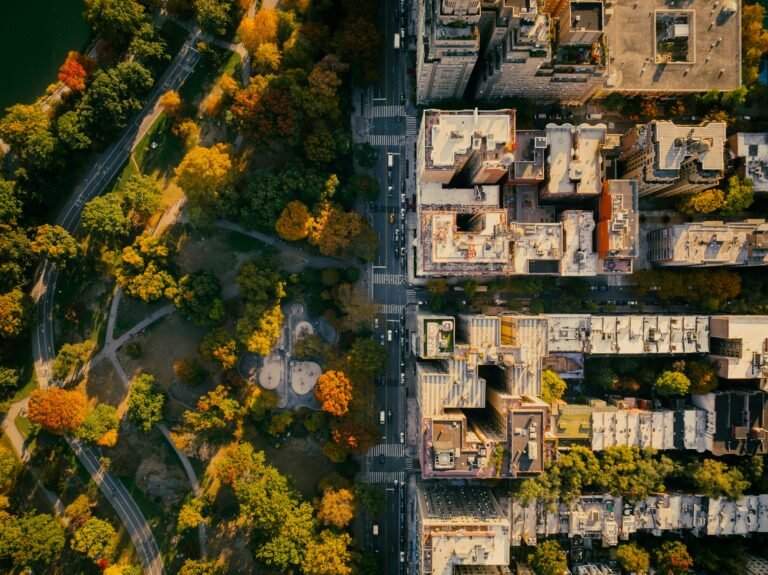
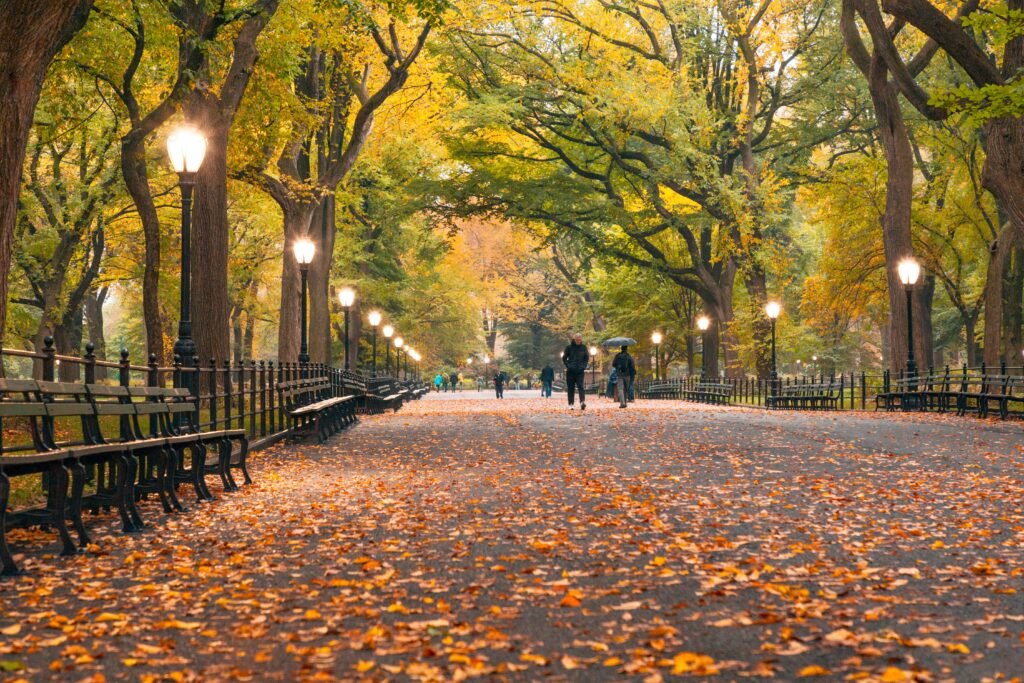
Central Park is worth visiting any time of year, but fall is when it earns the superlatives. The 843-acre park contains maples, oaks, ginkgos, elms, and dozens of other species, and as temperatures drop in October, the color comes in waves across different parts of the park. The Ramble — the wild woodland section in the mid-park — is particularly stunning: winding paths, a stream, and canopy so thick it blocks out the skyline entirely.
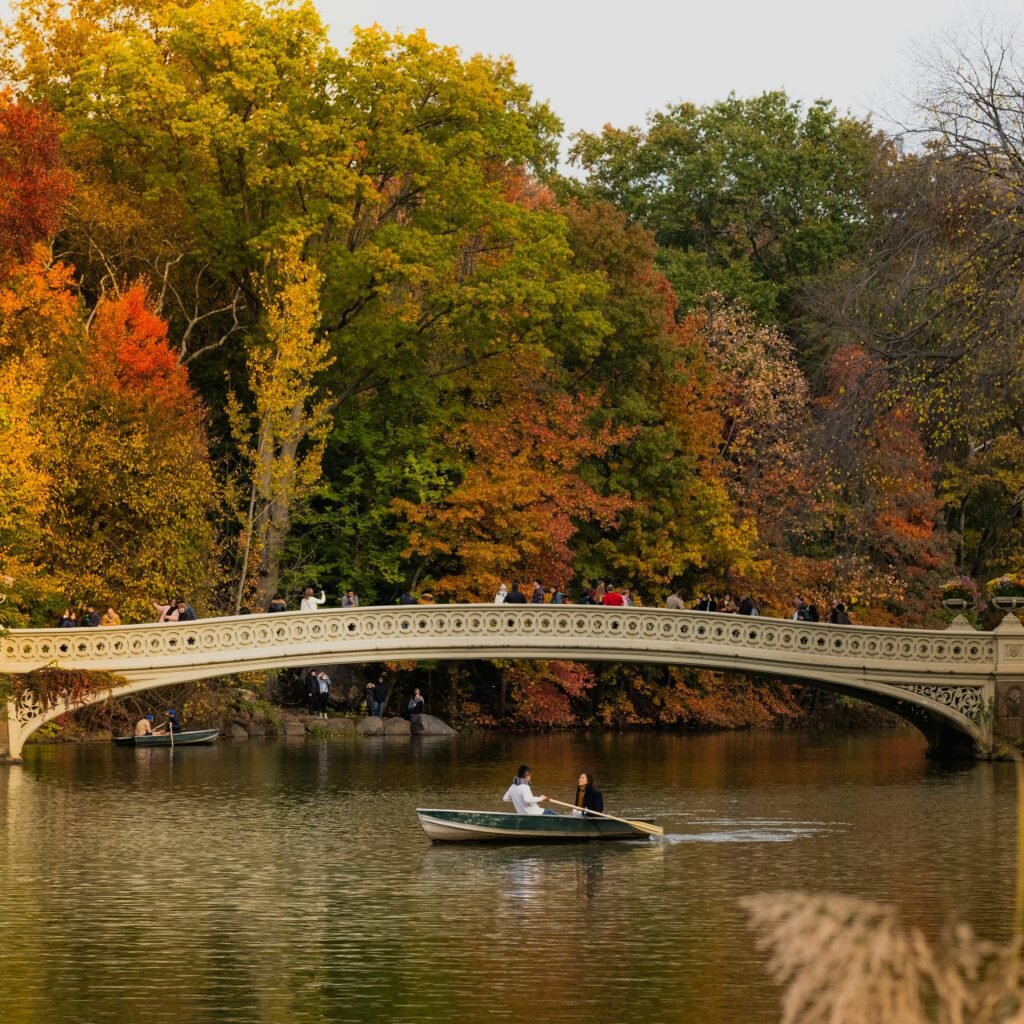
Other high-foliage areas include the North Woods (above 100th Street, significantly less visited), the Conservatory Garden on the east side near 105th Street, and the path around the Reservoir. For first-timers, the stretch between Bethesda Fountain and the Bow Bridge remains one of the most photographed scenes in American urban parks — and in October, with amber light and falling leaves, it earns every photo taken of it.
A guided walk is the easiest way to find the best spots without wandering for hours. The Central Park Guided Walking Tour on Viator covers the key landmarks and lesser-known corners in about two hours — useful if you want the best spots without the research.
2. The Village Halloween Parade — October 31
The Greenwich Village Halloween Parade is one of New York’s great spectacles: a mile-long procession up Sixth Avenue that draws tens of thousands of costumed participants and hundreds of thousands of spectators every October 31st. It’s the largest Halloween parade in the world, and it has an exuberant, community-made energy that’s impossible to replicate. Puppets the size of buildings, marching bands, elaborate costumes built over months — this is Halloween done at New York scale.
The parade runs from Spring Street to 16th Street along Sixth Avenue, starting around 7pm. Arrive early to secure a good viewing spot along the route. The blocks immediately around the West Village fill fast; positions near 10th or 12th Street tend to offer a better view-to-crowd ratio than the areas closest to the parade’s start.
3. Smorgasburg & Outdoor Markets
Smorgasburg is Brooklyn’s legendary open-air food market, and fall visits are typically excellent — the market usually runs into October at its Brooklyn locations. Check the official schedule before you go, since exact days and closing dates vary by season. It’s not just a food destination; on a clear fall Saturday, the Williamsburg location’s views across the East River to Manhattan are exceptional.
The Union Square Greenmarket also intensifies in fall: autumn squashes, apples, cider, pumpkins, and seasonal produce from dozens of upstate farms fill the market on Mondays, Wednesdays, Fridays, and Saturdays. It’s one of the most atmospheric farmers’ markets in the US when the leaves on the surrounding trees are turning.
4. Prospect Park Foliage Walk
Prospect Park in Brooklyn is Central Park’s less-visited equivalent, designed by the same landscape architects (Frederick Law Olmsted and Calvert Vaux) and widely considered their superior work. In fall, the Long Meadow — a nearly mile-long open grassland flanked by massive trees — is extraordinary. Locals come here for the same seasonal color that Manhattan visitors find in Central Park, minus the crowds and tour groups. Combine a foliage walk with a visit to the Brooklyn Museum or Brooklyn Botanic Garden nearby for a full day in the borough.
5. A Hudson River Fall Foliage Cruise
Manhattan sits between two rivers, and the Hudson Valley north of the city is one of the most spectacular foliage landscapes on the East Coast. Several operators run dedicated fall foliage cruises north along the Hudson River in October, letting you see the Palisades cliffs and forested riverbanks draped in color from the water. It’s a completely different perspective from anything you’d see on foot — and the views back toward the Manhattan skyline on the return are memorable. The Fall Foliage Cruise up the Hudson on Viator runs about 2.5 hours and operates specifically during peak foliage season.
Short on time? Central Park in October is the one non-negotiable — the Ramble alone takes two hours and covers everything fall in New York means at a walkable scale. Add the Hudson River cruise if you want something beyond the park, and the Halloween Parade if your dates line up.
Best Fall Events in NYC (September–November)
Fall in New York is event-dense in a way that few other cities can match. Here are the major ones worth planning around:
September
Broadway Opening Night Season (September–October). The new Broadway season launches in September, with the highest concentration of new show openings through October. If you want to see a show during its debut weeks — when the buzz is highest and the production is at its sharpest — fall is the time to be here. Book tickets several weeks in advance for the most anticipated openings.
Feast of San Gennaro (mid-September). Little Italy turns into an 11-day street festival centered around Mulberry Street, with food stands, music, crowds, and the kind of old-school New York energy that still feels worth seeking out. Go hungry, expect crowds, and treat it as a food-and-atmosphere stop rather than a quiet cultural afternoon.
New York Film Festival (late September–mid-October). Presented by the Film Society of Lincoln Center, this is one of the world’s most prestigious film festivals — less commercial than Sundance, more curated, and genuinely exciting for film enthusiasts. Screenings take place across Lincoln Center venues, and tickets are available to the public (not just industry).
October
Archtober (all October). New York’s architecture and design month brings talks, tours, exhibitions, and building-focused events across the city. If you like seeing the city beyond the obvious postcard sights, this is one of the smartest October angles to plan around.
Open House New York (mid-October). For one weekend, buildings and spaces typically off-limits to the public — industrial sites, private archives, historic rooftops, infrastructure — open their doors. Architecture enthusiasts should plan around this event specifically.
Village Halloween Parade (October 31). See above. Don’t miss it if you’re in town.
November
New York City Marathon (first Sunday of November). One of the world’s largest marathons, with over 50,000 runners passing through all five boroughs. The spectating is excellent — especially along the route in Brooklyn and at the finish line in Central Park. The city is electric on marathon Sunday. Be aware that major streets close for much of the day, so plan your movements around the route.
Macy’s Thanksgiving Day Parade (Thanksgiving morning). The balloon inflation happens the Wednesday night before Thanksgiving along Central Park West — free to watch, less crowded than the parade itself, and genuinely magical. The parade runs from 77th Street and Central Park West down to Macy’s at 34th Street — check the official Macy’s site for the exact start time. Street positions fill early; arrive at least an hour before the start if you want a good spot.
Where to See Fall Foliage in NYC
New York City is greener than its reputation suggests, and fall reveals a side of it that many visitors never expect. Here are the best foliage spots across the boroughs:
Central Park (Manhattan). The obvious choice, and for good reason. Focus on the Ramble, the North Woods, the Conservatory Garden, and the path around the Reservoir. The elm-lined Mall is also spectacular in late October when the canopy turns gold. Peak color typically hits mid to late October.
Prospect Park (Brooklyn). Larger tree species, fewer crowds, and arguably more dramatic color than Central Park. The Long Meadow is the standout. Peak timing is similar to Manhattan — mid to late October.
New York Botanical Garden (The Bronx). The NYBG’s 250 acres include an old-growth forest — a remnant of the original forest that covered the New York region — that turns magnificent in fall. The garden also runs dedicated fall foliage programming including guided walks. Requires admission, but for serious foliage seekers it’s worth the trip to the Bronx.
Wave Hill (The Bronx). A public garden overlooking the Hudson River and the Palisades, less visited than most major NYC green spaces and exceptionally beautiful in fall. The combination of garden plantings and Hudson Valley views makes this one of the most underrated spots in the entire city. Take the Metro-North to Riverdale station.
Inwood Hill Park (Upper Manhattan). At Manhattan’s northern tip, Inwood Hill Park contains old-growth forest and caves used by the Lenape people — genuinely ancient landscape within city limits. The fall color here is striking precisely because the trees are old and large, producing a canopy scale you won’t find farther south in the borough.
The Hudson Valley (day trip). If peak foliage is your primary goal, consider a day trip north of the city. Cold Spring, Beacon, or the Catskill foothills are all reachable by Metro-North in under 90 minutes and offer the kind of forest-everywhere color that NYC’s parks, for all their beauty, can’t fully replicate. Peak timing in the Hudson Valley runs about a week to ten days ahead of the city.
What to Wear & Pack for NYC in Fall
New York fall weather is genuinely variable, which means layering is the correct approach rather than packing for a single temperature range. Expect warm stretches in September (still possible to hit 80°F/27°C), cool days through October (50–65°F/10–18°C), and cold by November (dropping into the 40s°F/around 5–8°C, occasionally lower).
The essential items: a good walking jacket or medium-weight coat (a leather jacket is the local choice for October; a proper coat for November), layers underneath that you can add or remove during the day, comfortable walking shoes with some ankle support — the combination of uneven pavement, subway stairs, and long distances rewards shoes with actual sole cushioning — and a bag that fits your jacket when you end up carrying it.
Rain is a real possibility at any point in fall. A compact packable rain jacket is more useful than an umbrella in a city where you’re constantly moving between spaces. Skip the umbrella if you’re trying to pack light.
If you’re visiting for the Halloween Parade on October 31, keep in mind that even if the day is warm, evening temperatures in late October drop fast. Bring a layer that can go over whatever costume you’re wearing, or build the costume around something warm enough for 50°F.
Frequently Asked Questions
When is the best time to visit New York City in fall?
October is the sweet spot. The weather is reliably comfortable, fall foliage peaks mid to late in the month, the Halloween Parade happens on the 31st, and the city is in full swing without the extreme summer heat or holiday chaos. If you can only pick one fall month, pick October.
When does fall foliage peak in New York City?
Typically mid to late October in Central Park and most city parks, with some variation year to year depending on when the first sustained cold arrives. The Hudson Valley, further north, usually peaks a week to ten days earlier than Manhattan.
Is New York City crowded in fall?
Less crowded than summer, but not empty. October is genuinely popular, especially around fall foliage peak and Halloween. Expect hotels to fill and prices to rise in the second half of October. November is notably quieter until Thanksgiving week, which is busy again.
What are the best fall events in NYC?
The Village Halloween Parade (October 31), the New York Film Festival (late September to mid-October), Open House New York Weekend, the NYC Marathon (first Sunday in November), and the Macy’s Thanksgiving Day Parade (Thanksgiving morning) are the headliners. The balloon inflation the evening before Thanksgiving on Central Park West is one of the most underrated free events in the city.
Where is the best fall foliage in NYC?
Central Park’s Ramble and North Woods are the most accessible high-foliage spots in Manhattan. Prospect Park in Brooklyn rivals it in color and has far fewer visitors. For serious foliage, the New York Botanical Garden in the Bronx and a day trip to the Hudson Valley will exceed anything within city limits.
How cold does New York get in fall?
September is usually warm — often still summer-like, with highs in the 70s°F (21–26°C). October cools to the 50s–65°F range (10–18°C). November can drop to the 40s°F (4–9°C) and occasionally colder by month’s end. Pack layers and a proper coat for November.
Is Smorgasburg open in fall?
Usually, yes — Smorgasburg often runs into fall at select NYC locations, but exact days, locations, and closing dates vary by season. Check the official schedule before planning around it.
Fall in New York is the city at its most livable — the pace is familiar, the scale is still overwhelming in the best way, and the light, especially in October, makes everything look like it was art-directed. Come for the foliage, stay for the parade, and leave absolutely certain you’ll be back.