

How to Find Cheap Flights in 2026: The System That Actually Works
Affiliate disclosure: This post contains affiliate links. If you book or buy something through these links, I may earn a small commission at no extra cost to you. I only recommend things I genuinely use or believe in. Learn more.
Most advice about finding cheap flights is either obvious or wrong. Book on a Tuesday. Use incognito mode. Check at midnight. None of it is consistently true — airlines use dynamic pricing algorithms that change by the hour, and the idea that there’s a magic day or time to book is a myth that’s been debunked by every serious data analysis done on the subject. What actually works is a system: the right tools, used in the right order, at the right point in your planning. Here’s exactly what I use.
Finding cheap flights is just one part of planning a trip well. For the full picture — accommodation strategy, what to pack, how to pay abroad — see our complete trip planning guide. And once you’ve booked your flight, make sure your travel money card setup is sorted before you leave — it’s where most travelers lose money without noticing.
| How to Find Cheap Flights: Quick Reference | |
|---|---|
| Best search tool | Google Flights — most comprehensive, best calendar view |
| Best deal alerts | Going (formerly Scott’s Cheap Flights) — mistake fares and flash sales |
| Best for flexibility | Skyscanner “Everywhere” search |
| Domestic booking window | 15–30 days before departure (saves avg. $130 vs. 6 months out) |
| International booking window | 31–45 days before departure (saves avg. $190) |
| Cheapest travel days | Tuesday and Wednesday — up to 14% cheaper than Sunday |
| Cheapest month to fly | August — 29% cheaper than December on average |
Table of Contents
The Myths You Should Stop Believing
Before the system, a quick clearout of the advice that wastes your time:
- Booking on Tuesday is cheaper. It isn’t — not consistently. Airlines update prices constantly and there’s no reliable pattern by day of week for booking. The day you fly matters more than the day you book.
- Incognito mode shows lower prices. No evidence supports this. Airlines use server-side pricing, not browser cookies, to set fares. The price you see in incognito is the same price you’d see logged in.
- Book as early as possible for the best price. Sometimes true for peak season. Often not true for international flights, where booking 31–45 days out typically saves more than booking 6 months ahead.
- The cheapest flight is always the best value. A 4-stop itinerary that saves $80 but costs 9 hours of your time is not a good deal. This is an optimization problem, not a minimization problem.
Step 1: Start with Google Flights
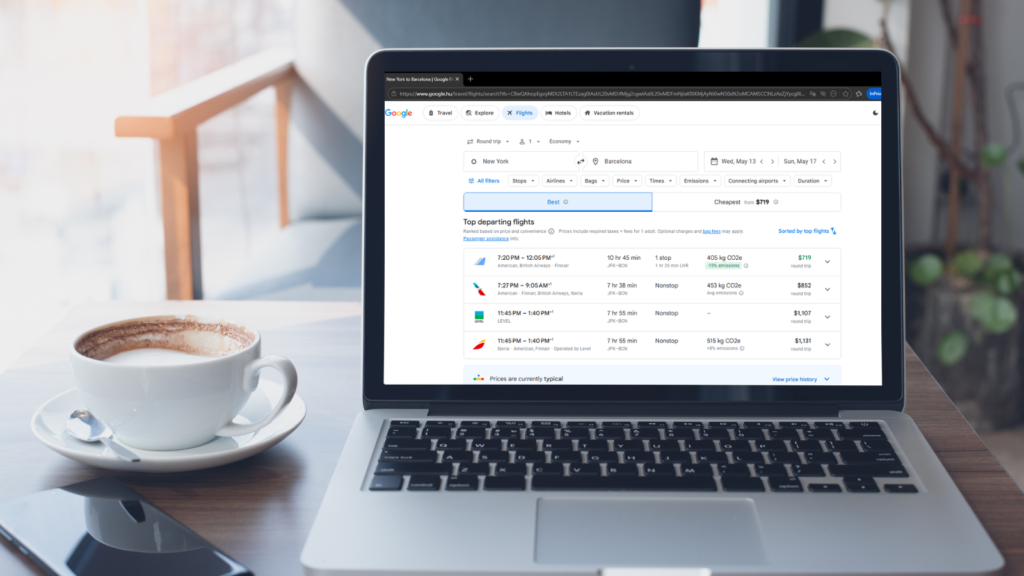
Google Flights is the best starting point for almost every flight search — not because it always has the lowest price, but because it gives you the best view of the pricing landscape before you commit to anything.
The feature most people miss: the calendar view. Instead of searching for a specific date, open the calendar and look at a month’s worth of prices simultaneously. Shifting your departure by two or three days can save $150–400 on an international flight — and the calendar makes this visible immediately without running separate searches.
The second underused feature: price tracking. Once you’ve identified a route and approximate date, click “Track prices.” Google will send you an email when the fare changes — up or down. This turns flight searching from an active task into a passive one: you set it up, get on with your life, and get notified when the price moves.
- Use the calendar view to find the cheapest days to fly in your window
- Use “Explore destinations” if you’re flexible on where you go
- Set price tracking once you know your route — then wait
- Always book directly with the airline after finding your price on Google — easier to manage changes or cancellations
Start your search on Google Flights here.
Step 2: Check Skyscanner for Alternative Routings
Google Flights is best for the routes you already know you want. Skyscanner is best for discovering routes you hadn’t considered.
The “Everywhere” search is the most powerful feature: enter your departure airport and leave the destination blank. Skyscanner returns the cheapest flights available from your airport across all destinations on your selected dates — or across an entire month if you choose “Whole month.” This is how you find the deals that don’t fit a plan, rather than searching for prices on a plan you’ve already made.
Skyscanner also consistently surfaces budget carrier options that don’t always show up fully in Google Flights — Ryanair, Wizz Air, easyJet, and regional carriers often appear more completely here. If you’re flying within Europe or looking for connections via budget airlines, Skyscanner is worth checking alongside Google.
- Use “Everywhere” when you’re flexible on destination
- Use “Whole month” when you’re flexible on dates
- Check for budget carrier coverage that Google might miss
Search flexible destinations on Skyscanner here.
Step 3: Set Up Fare Alerts with Going
Going (formerly Scott’s Cheap Flights) does something different from Google Flights and Skyscanner: it doesn’t just track prices, it actively hunts for mistake fares and flash sales — genuine anomalies where airlines price routes far below normal. These deals typically last 24–48 hours before the airline corrects them, which is why having an alert service matters.
In practice, this means occasionally receiving an alert for a transatlantic flight at $350 round trip when the normal price is $700. It doesn’t happen every week, but when it does, you need to be positioned to act on it quickly. Going sends the alert, you check your calendar, and you book before the window closes. That’s the entire workflow.
The free tier gives you access to some deals. The premium tier ($49/year) unlocks the mistake fares and business class deals, which is where the real value is. If you take two or more international flights per year, the premium tier pays for itself on a single booking.
Set up flight deal alerts with Going here.
When to Book: The Actual Data
The booking window question is the one most travelers get wrong — usually by booking too early, not too late. Here’s what the data actually shows:
| Flight type | Optimal booking window | Average savings vs. booking 6 months out |
|---|---|---|
| Domestic (economy) | 15–30 days before departure | ~$130 saved |
| International (economy) | 31–45 days before departure | ~$190 saved |
| International (last minute) | 8–15 days before departure | Up to $225 saved |
| Peak season (summer, holidays) | 3–6 months ahead | Avoids price spikes; book early |
The counterintuitive finding from Expedia’s 2026 data: for international flights, waiting until 31–45 days out saves more money on average than booking months ahead. Airlines often drop prices in the 4–6 week window before departure to fill remaining seats. The exception is peak season — summer and holiday travel, where you should book 3–6 months ahead to avoid the worst pricing.
My approach: I identify the route I want, set a Google Flights price tracker and a Going alert, then wait. If a deal comes in, I book it. If nothing exceptional appears by 5–6 weeks before departure, I book at whatever the current price is. I don’t try to time the exact bottom — I optimize the system and accept the result, the same way I approach index investing. Set up the process, let it run, don’t obsess over the last $20.
The Cheapest Days and Months to Fly
While there’s no magic booking day, there are genuine patterns in when to fly:
- Tuesday and Wednesday flights are consistently cheaper — Tuesday flights run about 14% less than Sunday departures, saving roughly $56 per ticket on average.
- Early morning and late evening flights (before 7am and after 9pm) are typically cheaper than midday — less convenient, but the price differential is real.
- August is the cheapest month to fly in 2026, averaging 29% less than December — roughly $120 cheaper per ticket. Early June (June 1–14) and late August (August 18–31) are the sweet spots within summer.
- January and February are the cheapest months for domestic US travel — demand drops sharply after the holiday period.
How to Use Stopovers to Find Cheaper Flights
One of the most underused strategies for reducing airfare is deliberately choosing a routing with a meaningful stopover — and treating the connection as a destination rather than a delay.
Several major airlines have official stopover programs that let you spend 1–7 days in their hub city at no extra airfare cost. Turkish Airlines lets you spend up to 7 days in Istanbul with a free hotel included. Icelandair lets you add Iceland to any transatlantic itinerary. TAP Air Portugal lets you stop in Lisbon or Porto on the way to anywhere in Europe.
The result: a flight that might be $50–100 cheaper than a direct routing, plus a free extra destination. This is not a marginal optimization — it’s a fundamentally different way to structure international travel. For the full breakdown of every airline that offers this, see our free stopover flights guide.
The Credit Card Points Layer: How It Changes the Math
Everything above assumes you’re paying cash for flights. If you’re earning and redeeming travel credit card points, the calculation changes significantly — and this is where the real optimization happens for frequent travelers.
The basic mechanic: travel credit cards earn points on every purchase you make, including spending that has nothing to do with travel. Those points transfer to airline programs and can be redeemed for flights — often at a value of 1.5–2 cents per point, compared to the 1 cent per point you’d get from cashback. A card with a 3x points multiplier on travel and dining effectively gives you a 4.5–6% return on that spending when redeemed for flights.
I think about this the same way I think about any long-term compounding system: the individual transactions seem small, but over a year of normal spending the accumulated points add up to meaningful free flights. I’m not spending more than I would otherwise — I’m just making sure every transaction works slightly in my favor. It’s the travel equivalent of an ETF: low effort, consistent returns, no active management required.
The key requirements for a travel credit card worth using for this strategy:
- No foreign transaction fee — essential for international use
- Strong points multiplier on travel and dining purchases
- Points that transfer to airline partners (not just fixed-value cashback)
- A welcome bonus that covers a significant portion of the first year’s flights
For more on how to set up a no-fee travel card system for international spending — including Wise and Revolut for day-to-day costs — see our best travel money card guide.
Flying with a Toddler: How It Changes the Flight Search
Searching for cheap flights with a young child adds constraints that most flight-finding guides don’t address. Here’s what we’ve learned from flying with a toddler:
- Non-stop is almost always worth the premium. The cheapest option with two connections saves money and costs you something that isn’t on the price tag. A direct flight that costs $100 more is often the right call.
- Flight timing matters more than for solo travel. A 6am departure that works fine for adults is genuinely difficult with a toddler in tow. Red-eye flights can work well if your child sleeps on planes — ours does — but midday is the hardest timing.
- Check the airline’s lap infant and child seat policies before booking. Under-2s fly free as lap infants on most international routes, but policies vary significantly. On some airlines, buying a seat for a toddler unlocks bulkhead seating — worth checking.
- Use the 24-hour cancellation rule. Book the flight you want, then spend 24 hours confirming the timing works for the trip. Cancel and rebook if something better appears. This applies to all US airline bookings made at least 7 days before departure.
The Full Cheap Flights System: Step by Step
| Step | Action | Tool |
|---|---|---|
| 1 | Search the route, check the calendar view for cheapest days | Google Flights |
| 2 | Check for budget carrier options and alternative routings | Skyscanner |
| 3 | Set a price tracker on your preferred route | Google Flights |
| 4 | Set up fare alerts for mistake fares and flash sales | Going |
| 5 | Consider stopover routing for cheaper fares + free extra destination | Stopover guide |
| 6 | Book directly with the airline once you find your price | Airline website |
| 7 | Use the 24-hour cancellation window to confirm the booking works | Your calendar |
| 8 | Earn points on the purchase with a no-fee travel credit card | Card guide |
My Personal Pick: What I Actually Use
For context on how this works in practice: I use Google Flights as my primary search tool for every trip. I set price trackers on routes I’m serious about, and I have Going set up for alerts from my home airports. When a deal comes in I check the calendar, confirm it works with our schedule, and book directly with the airline.
For European travel specifically — which is where most of our trips go — I’ve found that routing via Istanbul on Turkish Airlines frequently surfaces cheaper options than direct transatlantic routes, and the stopover program turns the connection into an asset rather than a cost. That one shift in how I think about routing has changed the economics of several trips.
The credit card points layer runs in the background permanently — I’m not doing anything active with it, just making sure the right card is used for the right purchases. Over the course of a year it accumulates into something meaningful.
Final Thoughts: How to Find Cheap Flights in 2026
Finding cheap flights reliably isn’t about knowing a secret trick. It’s about having a system that runs consistently: the right search tools, price tracking set up in advance, fare alerts for genuine deals, and a flexible enough approach to take advantage of opportunities when they appear.
The biggest gains come not from obsessing over small price differences but from the structural decisions: being flexible on travel dates, considering stopover routings, using credit card points on spending you’d make anyway, and booking at the right point in the pricing cycle rather than as far ahead as possible.
| Before Your Next Flight Search | |
|---|---|
| Search and compare routes | Google Flights + Skyscanner |
| Set up deal alerts | Going (formerly Scott’s Cheap Flights) |
| Consider a stopover routing | Free stopover flights guide |
| Set up your travel money card | Wise + Revolut guide |
| Plan the full trip | Complete trip planning guide |